
It is the notification we all dread. The professor clicks "Submit" on the Canvas announcement, and there it is: Group Assignments. Within seconds, you are added to a WhatsApp group with three people you have never met. You send a friendly "Hey guys, when should we start?" and nothing. Silence. For 72 hours.
Meet Mona. Mona is the student who actually cares. She has her Notion pages ready, her color-coded calendar set, and a burning desire to maintain her GPA. But Mona has just been paired with "The Ghost" (who hasn't checked the chat in a week), "The Professional Victim" (who has a crisis every time a deadline nears), and "The Bare Minimum" (who thinks one bullet point counts as a three-page section).
Real talk: group projects are the final boss of university life. In 2026, remote collaboration and digital ghosting have made it easier than ever for people to disappear into the void. But you don't have to be a martyr. You can be a leader.
Here is how to carry the team without burning out.
Phase 1: Identifying the Slacker Personas
To solve the problem, you have to understand the psychology of why it is happening. Researchers call this Social Loafing, also known as the Ringelmann Effect. It is the scientific truth that individuals exert less effort when they are part of a group because they feel their lack of work will be hidden by the collective. When responsibility is diffused among four people, each person feels only 25% responsible for the failure.
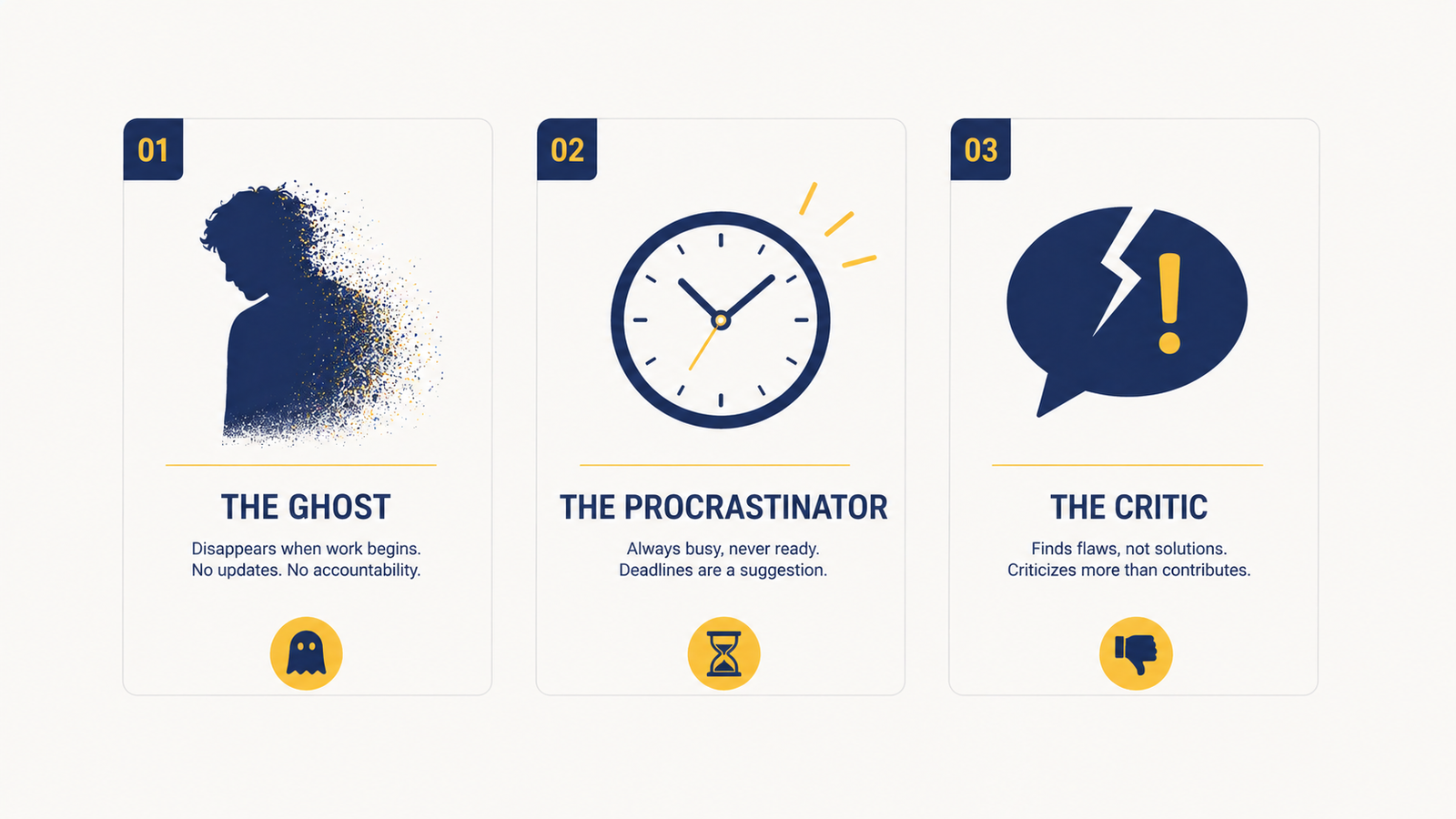
In your group, you will likely find these archetypes:
- The Ghost: They never show up to meetings and their phone seemingly only works for TikTok, not group chats.
- The "I'll Do It Later": They promise the world on Monday but submit a rough draft full of typos at 3 AM on the day it is due. They rely on your panic to fuel their last-minute brilliance, which is usually just mediocre work.
- The Critique-Only Member: They contribute zero words to the document but have plenty of opinions on why your work isn't quite right. They use feedback as a way to look engaged without actually doing the heavy lifting.
- The Accidental Tourist: This person is nice, but completely lost. They want to help, but they lack the skills or confidence to contribute meaningfully.
Phase 2: The Team Charter Strategy
The biggest mistake Mona and most of us makes is assuming everyone has the same work ethic. They don't. Some people are satisfied with a C while you are aiming for a 4.0 GPA. You have to force clarity from day one.
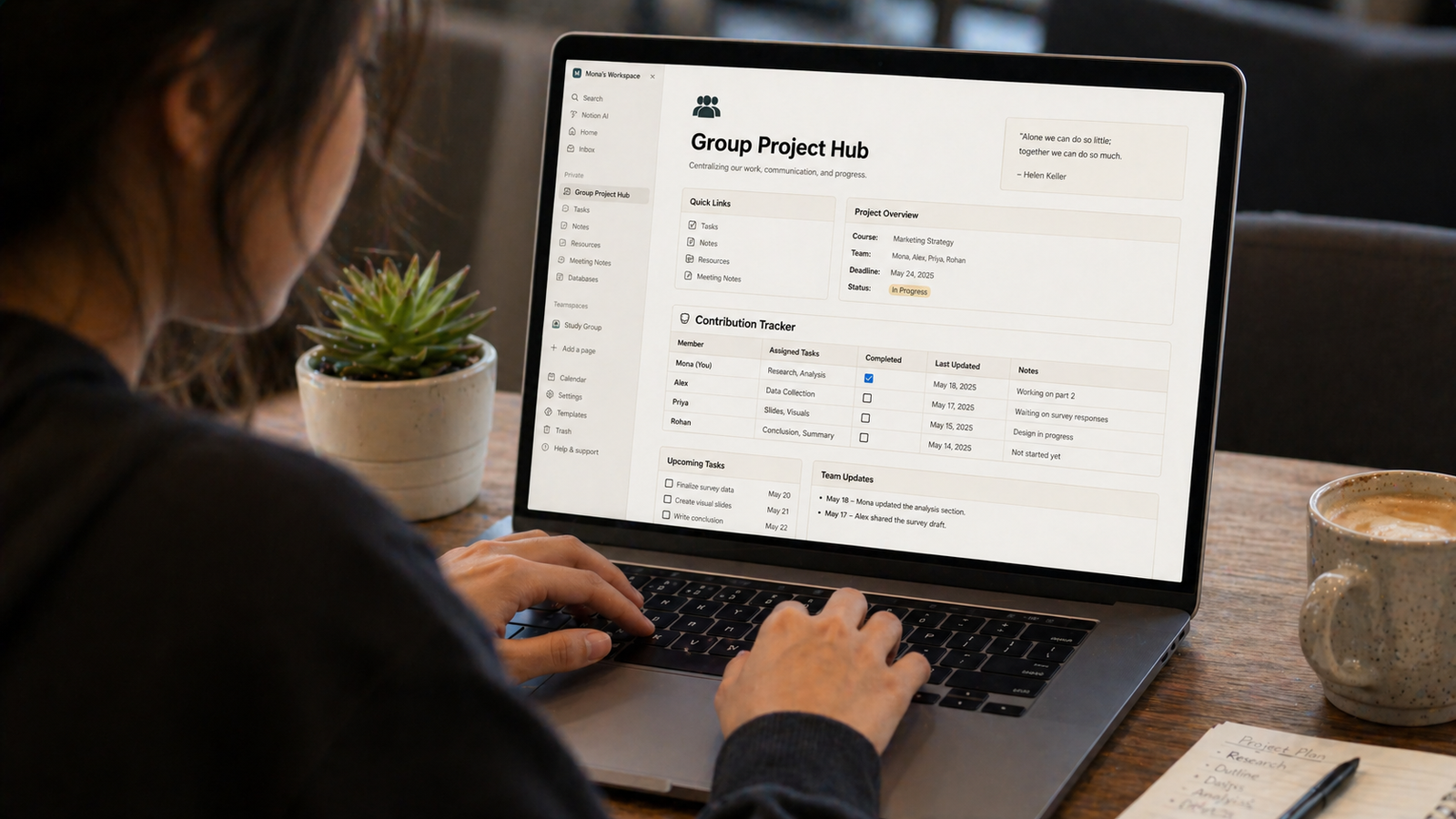
Don't just "assign parts." Create a Team Charter in a shared Notion page.
1. Define the Meta
Break the project into roles. Instead of everyone "working on the intro," assign one person as the Lead Researcher, one as the Editor, and one as the Visual Designer. When a specific name is attached to a specific task, Social Loafing becomes much harder to pull off because the diffusion of responsibility disappears.
2. Set Internal Deadlines
Your group deadline should never be the actual submission deadline. If the project is due Friday, your Team Deadline is Tuesday. This gives you a buffer zone to fix the inevitable train wreck that the procrastinator will submit at the last minute.
3. The Paper Trail
Use a Contribution Log. In 2026, transparency is your best friend. If all the work is happening in a shared Google Doc or Notion page, the Version History becomes your legal evidence if things go south. Make it clear to the group: "The professor can see who wrote what in the version history, so let's make sure we all have our names on some blocks of text."
Phase 3: The Confrontation (Without Being a Jerk)
Passive-aggression in the group chat solves nothing. Sending three question marks after a ghosted message just makes you look stressed and them feel defensive. If someone isn't pulling their weight, you need a Gentle Nudge.
Try this script: "Hey [Name], I noticed your section is still blank. We're aiming to have a rough draft by Thursday so we have time to edit. Is everything okay on your end, or do you need help with that topic?"
This does two things: it sets a firm deadline and offers support. It forces them to either admit they are struggling or admit they are slacking.
When to Pull the 1-on-1
If the group chat nudge doesn't work, message them privately. A private 1-on-1 is much more effective than public shaming in a group chat. Ask them if there is a specific part of the assignment they feel more comfortable with. Sometimes "The Ghost" is just a student who is overwhelmed and doesn't know where to start.
The Nuclear Option
You are not a snitch for protecting your grade. If a team member has been truly MIA, send a professional, data-backed email to your professor. Don't make it emotional. Just say: "We have reached out to [Name] on three separate occasions (see attached screenshots) and have not received their portion of the work. How would you like us to proceed regarding the grading breakdown?" Most professors prefer to know this before the grade is given so they can adjust individual scores.

Phase 4: How to Carry Without Crashing
Sometimes, despite your best efforts, you just have to do the work yourself. It sucks, but your GPA is worth it. To survive "The Carry," use the Minimum Viable Product (MVP) mindset.
Focus on the 20/80 Rule
80% of the project's grade usually comes from 20% of the core content. If "The Ghost" was supposed to write a minor section on the history of the topic and they haven't done it, don't write five pages for them. Write a half-page summary that covers the essentials. Focus your best energy on the executive summary, the core analysis, and the final presentation because those are the parts the professor actually looks at first.
Use AI as Your Intern
If a teammate submits messy work that you have to fix, don't rewrite it from scratch. Use AI tools to clean up their grammar, fix the formatting, and summarize their rambling points into something usable. This allows you to carry the workload in 30 minutes instead of three hours.
Protect Your Self Box
Don't let their laziness eat into your gym time or sleep. Set a hard stop time for project work. If the project isn't perfect by 10 PM, it's okay. A 95% is better than a 100% if the 100% costs you your sanity. Remember the 3-Box Rule: your Self and Social boxes are just as important for long-term academic survival as your Study box.

Phase 5: Leadership Lessons from the Trenches
Here is the truth no one tells you: the slackers are giving you a secret gift. By being forced to carry the team, you are building Project Management and Conflict Resolution skills that are worth more than the degree itself.
In the real world, you will rarely work with a team where everyone is a 10/10 performer. You will always have ghosts, procrastinators, and critics. Learning how to manage them now, without losing your mind, is what separates a student from a professional.
- Delegation is a Skill: Learning how to assign tasks based on people's limited strengths is a management superpower.
- Conflict is Data: Every time "The Ghost" misses a deadline, it is data on how you need to adjust your Team Charter for the next project.
- The Reputation Economy: People notice who the carries are. Professors notice. Ambitious peers notice. By being the reliable leader, you are building a reputation that leads to better group invites in the future.
The Final Debrief
Group projects are a test of character as much as they are a test of subject matter. Mona's journey from Stressed Martyr to Project Manager is the ultimate level-up in her undergrad life.
Don't let a bad team kill your undergrad vibe. Take control, document everything, use the AI tools at your disposal, and keep your eyes on the prize: that A+ and the leadership skills to match.
Want the exact Notion templates, Team Charter frameworks, and Gentle Nudge scripts mentioned in this post? Join the Undergrad Vibes newsletter and get the tools you need to win the group project game every semester.
This post contains affiliate links. We only recommend tools that help you work smarter, not harder.